Yeast Sandwich Bread Recipe

There’s nothing quite like the aroma of homemade bread wafting throughout the house. If you’ve been a bit intimidated trying to figure out how to get started, look no further! The process is much simpler than you’d think, and with the help of a stand mixer, you can get the job done with minimal effort. Set aside three hours and you will have two beautiful loaves of homemade sandwich bread ready for your next lunch or supper. *If you don’t have a stand mixer, you can still use this recipe and do the kneading by hand.*
Cost Savings
When I first started baking bread, my main goal was to save money by making more of our food from scratch. This can be a difficult endeavor, because a good portion of processed foods on the grocery store shelves are cheap. I can buy a loaf of bread for $1.69, but can I make it any cheaper than I can buy it? Let’s do some math. A 25 lb bag of flour at a big discount club is about $10. This will contain about 80 cups of flour. My recipe calls for 3 cups per loaf, so I can make 26 loaves from that. Each loaf contains 38¢ of flour. A pound of yeast is about $10 also, and you can get 53 tablespoons from that amount. It takes 1/2 a tablespoon per loaf, so that is 9¢ per loaf. If I use white sugar and vegetable oil, there’s 9¢ of sugar and 14¢ of oil. In total, I can make a loaf of bread for a whopping total of 70¢. If this is you, then good news, you have the power to reduce your grocery budget! As a young mom of many kids, this was me for a season of life.
This post contains affiliate links, which means I make a small commission at no extra cost to you. See my full disclosure here.
Health Benefits
Later in my homemaking journey, I began to really care about the ingredients in our food. After dealing with food sensitivities, autism and ADHD diagnoses, and gut problems in my children, I went down the rabbit hole of learning how to get processed foods and toxins out of our diet. One of the things I care about keeping out of our diet is glyphosate. Almost all American wheat is going to be sprayed with glyphosate, but there are a few options. First, any flour that you get from Azure Standard will be free of glyphosate. Make sure you are getting a “white bread” flour such as All-Purpose. What I am currently using is King Arthur Baking – Organic Bread Flour.
Of course, buying organic flour means that we are no longer making bread for cheap, but we must compare apples-to-apples. I may be able to buy glyphosate-covered, enriched white breads for cheaper than I can make organic bread, but the organic homemade bread is still superior to any store-bought organic bread, which are going to be considerably more expensive and still have far more ingredients than our 5-ingredient homemade loaf (6 ingredients, counting the water).
Proofing
The first step to making a yeast bread is to proof the yeast. We do this by combining the yeast, water, fat, and sugar, giving it a stir with a whisk, and letting it sit until the yeast forms a foam, which “proves” it is active and alive. Each of these ingredients is important for good sandwich bread.
Water
Filtered water is best, but I’ve had luck with tap water also. This will vary depending on what’s in your city or well water. Hard minerals and chlorine can affect both the taste and the texture of your bread. When possible, use filtered water. It is also important for the water to be between 105º and 110º Fahrenheit. That’s hot enough to activate the yeast, but not hot enough to kill it.
Yeast
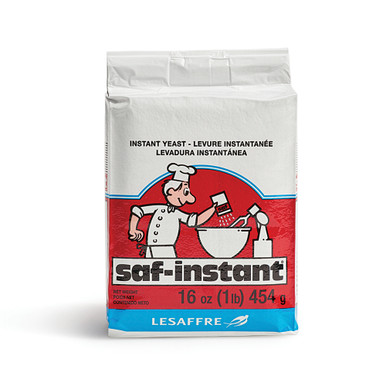
You can use an active dry yeast, but my favorite yeast to use is King Arthur Baking – SAF Red Instant Yeast. And instant yeast is going to proof in about 5 minutes as opposed to 15-30 minutes, and make your baking day much shorter. I personally have never had a loaf NOT proof with SAF, but I have had several failures with other brands of active dry yeast. One tip that will make your yeast last is to store it in the freezer. I keep mine in this King Arthur Baking – 3-Cup Yeast Airtight Canister, which I love because it’s not glass. I store almost everything in my house in glass, but my yeast has gotten broken in the freezer when I had it in a mason jar, so I decided to get a BPA-free plastic canister instead. It also fits a one pound package of yeast in it perfectly!
Sugar
Sugar is something that can be optional in a sandwich bread. There are some benefits, such as enhanced flavor and softness. It can also be useful to use sugar in the proofing stage to make sure your yeast is nice and active. If you’re just starting out, I would suggest following the recipe and using the sugar, and then you can experiment with reducing or omitting it later. Raw honey can also be used in place of white sugar. I have also used an organic cane sugar that has only been minimally processed so retains some of the very light brown color and slight taste of molasses. I get mine from Azure Standard.
Fat
Fat makes sandwich bread tender and helps create a tight crumb. Some people use a vegetable or canola oil, but these are highly processed oils I prefer not to use. If this is what you have on hand, it’s perfectly fine to use them. I have used a light olive oil. Extra virgin olive oil tends to be too heavy for my liking. I also like melted unsalted butter.
Mixing and Kneading
The next step after the yeast has proofed is to add in the flour and the salt. Don’t make the mistake of forgetting the salt (ask me how I know!). The amount of flour is going to vary based on the temperature in your kitchen and the humidity. That means that you may be adding more or less flour to this recipe during different seasons throughout the year. As you practice making bread, you will learn to see when the dough is the right consistency. I suggest starting off with all but the last cup of flour, mix it a bit on the lowest speed, and then add in about 1/4 cup of flour at a time until the right consistency is reached. *Be sure you are using the dough hook attachment.* What you want to see is a dough that is no longer sticking to the sides of the bowl, and use no more flour than necessary to reach that stage. At this point, increase the speed to level 2 and knead to dough for 10 minutes. After that amount of time, you should be able to pull on the dough slightly without it tearing.
Flour
You can use bread flour or all-purpose flour for this recipe, but I prefer bread flour. It create a chewier, less crumbly bread that doesn’t fall apart as easily, which is ideal for sandwiches. If you prefer an organic option, try King Arthur Baking – Organic Bread Flour, or King Arthur Baking – Organic All-Purpose Flour. You could also use one of the many flours on the Azure Standard website.
First Rise, and Shaping the Loaves
After the mixing and kneading you will place your dough into a lightly oiled mixing bowl and cover it with a lightly oiled piece of plastic wrap, or a damp tea towel. You want the bread to double in size. This process should take about an hour, but can go more quickly or slowly depending on the temperature in your kitchen. It will rise faster in a warmer kitchen and slower in a cooler kitchen. After the dough has doubled, turn it out onto a lightly floured work surface and divide it into two equal pieces. Shape them one at a time into a rectangle about the length of your loaf pan. I really like the USA Pan. I have the 1.5 lb pan, and I find that it makes a loaf slightly longer than my small stoneware pans, and pretty consistency give me a 1.5 lb loaf of bread, within an ounce more or less. This recipe yields two loaves of this size. Begin shaping the loaf by picking up the top of the rectangle and folding it down toward the middle of the rectangle. Press this seam to seal it. Do this twice more, and also tuck it under at the ends. Make sure you pinch the final seam, and place the loaves seam side down in the loaf pans. Set these aside to rise for the second time.
Second Rise, and Bake
This time the loaves will rise in the loaf pans and reach their final shape before baking. As I said before, the temperature in your kitchen will determine rise time. One trick is to pre-heat your oven to the lowest temperature available, usually 150º-170ºF. As soon as it pre-heats, TURN OFF THE OVEN, and place the loaves inside the warm oven to speed up rise time. It is important that you don’t over-proof your bread, or it will fall once it’s baked. Once they reach at least one inch over the top edge of the loaf pans, they are ready to bake! Pre-heat the oven to 350ºF and bake the bread for 35 minutes. When it is done, immediately turn the loaves out of the pans and onto a cooling rack. If you can resist cutting into them right away, you will get better results by letting them cool completely, which will be about 2 hours, more or less.
Slicing and Storing
I have found that letting them cool even longer, sometimes overnight if I’ve made the bread in the afternoon, helps the slices to be more even since the bread doesn’t smush as much on the top when you apply pressure with the knife. Make sure you are using a sharp serrated bread knife. If you prefer, you can even use a deli slicer. We have a Beswood 10″ Deli Slicer with a bread guard. Cutting it on a level 12 is perfect for sandwich slices.

At this point you want to store your bread properly. I like the King Arthur Single Bread Bags – 100 Count (Search Item #201496). I found some inexpensive twist ties on Amazon to secure them. We often make four loaves at a time because our family is so large, eat one immediately, and save the other three as sandwich loaves in the pantry. They will stay fresh for about 3 days before beginning to go stale, at which time they are great for French Toast, homemade croutons, or perfect to be placed in the food processor for bread crumbs.

And there you have it! Delicious yeast sandwich bread that you can make at home. You control the ingredients, and it’s truly one of the easiest things to make to replace your grocery store purchases.
This post contains affiliate links, which means I make a small commission at no extra cost to you. See my full disclosure here.
Yeast Sandwich Bread Recipe
Print RecipeEquipment
- Stand Mixer with dough hook (optional)
- 2 Loaf Pans 1.25 or 1.5 lb pans
- 1 Large bowl for rising
- Plastic wrap or damp tea towel
Ingredients
- 1 Tbsp yeast
- 1/4 cup sugar or honey
- 1/4 cup oil or melted butter (unsalted)
- 2 cups water
- 5-6 cups flour
- 1 tsp salt
Instructions
- Add yeast, sugar, oil, and water in bowl of stand mixer. Stir with a whisk. Let the yeast proof until it forms a foam (5-30 minutes depending on your yeast).
- Add 5 cups of flour and the salt to the yeast mixture. Attach dough hook to stand mixer. Mix on STIR until the dough is combined, then raise the speed to 2. If the dough is sticking to the sides of the bowl, add more flour, a little at a time. 5-6 cups of flour is typical for this recipe, and I usually am closer to 6, but this can vary based on humidity and temperature. Once the dough isn't sticking to the bowl, knead for 10 minutes. You can do all of the mixing and kneading by hand if you don't have a stand mixer.
- After kneading, place bread in a lightly oiled large bowl and cover with a lightly oiled plastic wrap, or with a damp tea towel. Let dough rise for about 1 hour or until doubled in size.
- Scrape dough out of bowl onto a lightly flour work surface. Divide into two sections. Shape each section into a loaf and place the two loaves into loaf pans. Let rise for an additional 45 minutes to an hour, or until the bread has risen at least an inch over the top of the loaf pan.
- Preheat oven to 350ºF, and bake loaves for 35 minutes. When finished, immediately take them out of the loaf pans and place onto a cooling rack. For best results, let cool completely before slicing.
